Body Mass Index (BMI) is one of the quickest ways to get a snapshot of your weight relative to your height, and millions of people search for it every day. Whether you’re checking general health, tracking fitness progress, or filling out a medical form, knowing your BMI helps you and your healthcare team ask the right follow-up questions. Height, weight, and age influence overall health assessments, and BMI is the common denominator used to compare people of different sizes.
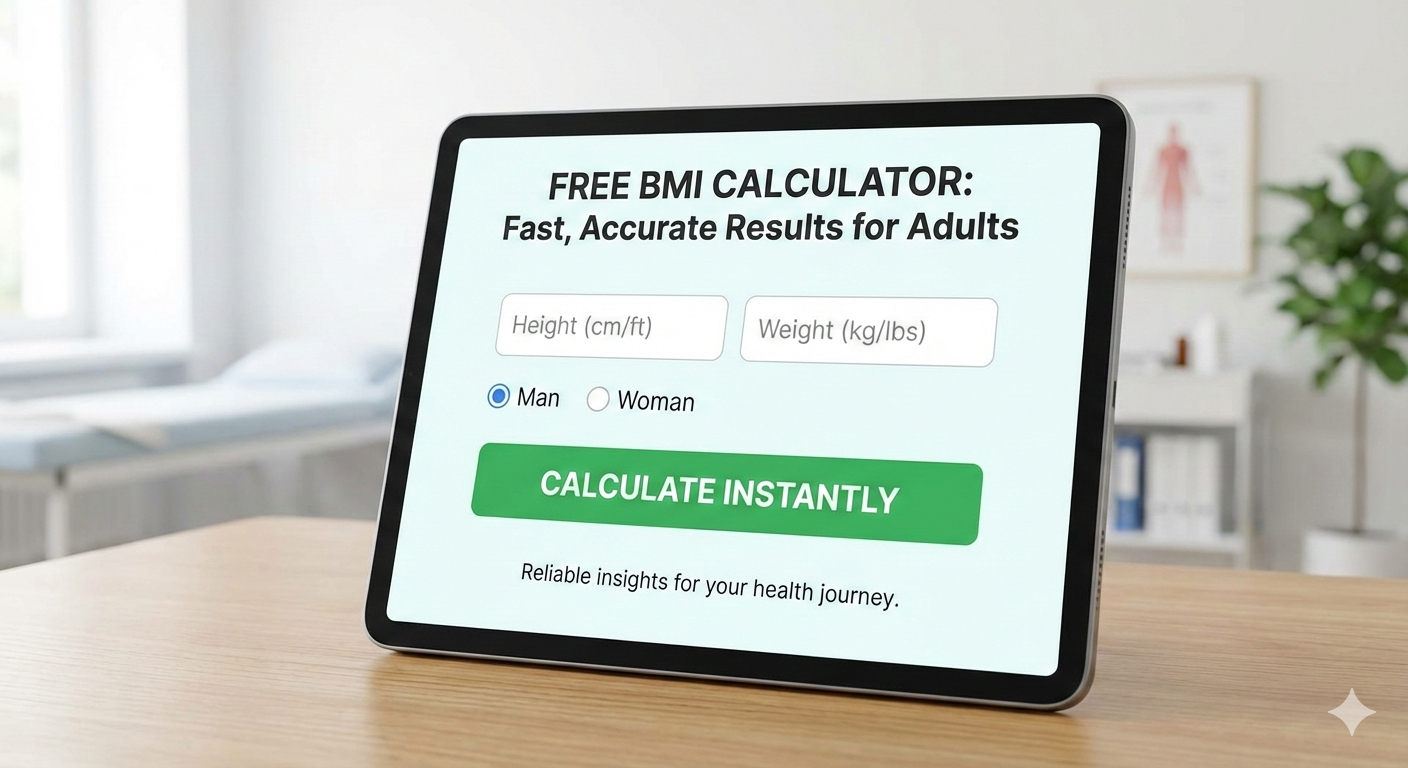
Our free BMI calculator delivers a fast, accurate BMI number in seconds. Enter your height and weight (choose metric or imperial), and the tool returns your BMI and the WHO category (underweight, normal, overweight, obese). We also provide tailored guidance for the BMI calculator men and the BMI calculator women, so you can interpret results with real-world context. Use the calculator as a starting point, not a medical verdict, and combine it with other measures for a fuller picture of health.
Table of Contents
- What Is BMI?
- How the BMI Calculator Works
- BMI Ranges for Adults (Men & Women)
- BMI Calculator for Women
- BMI Calculator for Men
- Limitations of BMI
- How to Improve Your BMI Safely
- Conclusion
- FAQ
What Is BMI?
Body Mass Index (BMI) is a mathematical index used to classify weight relative to height. It was developed as a population-level screening tool and is widely used because it’s easy to calculate and standardizes comparisons.
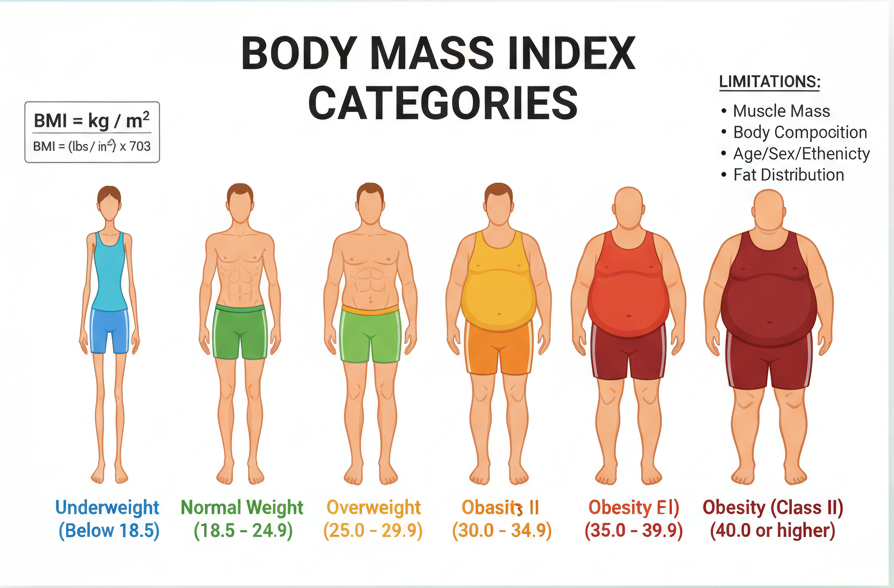
The formula is:
Metric:
BMI = weight (kg) / height (m)2
Imperial:
BMI = weight (lb) / height (in)2 × 703
BMI is a screening tool that flags whether someone falls into commonly used weight categories. It does not directly measure body fat and cannot diagnose health on its own. Instead, BMI helps clinicians and individuals decide whether further testing (waist measurement, body-fat analysis, metabolic labs) is warranted.
Typical uses: Quick population studies, initial health assessments, tracking weight trends over time, and guiding conversations about diet, exercise, and risk factors. Because BMI is easy to compute, a reliable BMI calculator is a convenient first step in a health checkup.
How the BMI Calculator Works
A BMI calculator runs the same formula above, but removes the risk of human error in unit conversion and arithmetic. Here’s what it does behind the scenes:
- Input collection: You enter height and weight. The tool supports both metric (kg, m, or cm) and imperial (lb, ft/in) units. Some calculators also accept age and sex for contextual guidance (though the BMI formula itself does not use them).
- Unit conversion: If you enter feet/inches or pounds, the calculator converts them to meters and kilograms (or applies the ×703 factor for imperial).
- Apply formula: The calculator computes BMI using the exact formula and returns the result to 1 or 2 decimal places for clarity.
- Category mapping: The result is mapped to standard BMI categories (underweight, normal, overweight, obesity) and displayed with explanatory text.
- Contextual notes: For men and women, the calculator may add interpretation notes because the BMI calculator for men and women reflects that body composition differs by sex (muscle mass, hormonal cycles), which affects interpretation.
BMI Ranges for Adults (Men & Women)
Health authorities (including WHO and the CDC) use standard BMI categories for adults; the cutoffs are the same for men and women, though clinical interpretation considers sex-specific body composition.
WHO adult BMI categories:
- Underweight: BMI < 18.5
- Normal (healthy) weight: BMI 18.5 – 24.9
- Overweight: BMI 25.0 – 29.9
- Obesity class I: BMI 30.0 – 34.9
- Obesity class II: BMI 35.0 – 39.9
- Obesity class III (severe): BMI ≥ 40.0
What these ranges mean (brief):
- Underweight can signal nutritional deficiencies or underlying illness.
- The normal range is associated with lower population risk for many chronic diseases.
- Being overweight indicates increased risk for conditions such as type 2 diabetes and cardiovascular disease.
- Obesity (classes I–III) corresponds to progressively higher risk and typically triggers medical evaluation and intervention.
Although the numeric ranges are identical across sexes, men and women store fat differently: women usually carry more body fat as a percentage of body weight. In contrast, men typically take more lean mass (muscle).
Accordingly, a muscular man may have a lower body fat percentage but a higher BMI, while an older woman may have a normal BMI but a higher fat percentage. Use BMI as a screening measure, then follow up with waist circumference, body-fat testing, or a clinician’s assessment for individualized guidance.
BMI Calculator for Women
A BMI calculator for women uses the same mathematical formula as for men, but interpretation comes with essential caveats because female physiology and life stages affect body composition:
- Higher average body-fat percentage: Women naturally have a higher rate of body fat than men, which supports reproductive and hormonal functions. For the same BMI, women often have a slightly higher fat proportion.
- Hormonal changes: Pregnancy, postpartum recovery, and menopause shift body fat distribution. For example, weight gain during pregnancy is expected and healthy; interpreting BMI during pregnancy requires obstetric guidance rather than standard BMI cutoffs.
- Fat distribution: Women often store fat around the hips and thighs (gynoid pattern), whereas men more commonly store abdominal fat (android pattern). Central (abdominal) fat is more strongly linked to metabolic risk than peripheral fat.
When not to rely solely on BMI:
- Pregnancy and postpartum: Use obstetric charts and provider guidance.
- Highly trained athletes: High muscle mass can inflate BMI.
- Older adults: Sarcopenia (loss of muscle) can mask excess fat despite normal BMI.
A BMI calculator for women is a practical screening step. It helps track trends, communicate with healthcare providers, and decide when to pursue more precise measures (such as DEXA scans, bioelectrical impedance, or waist-to-hip ratio).
BMI Calculator for Men
The BMI formula is the same for everyone, but interpreting the result for men requires context. Men typically have higher lean body mass, more muscle, and bone density, so a muscular man can have a BMI in the “overweight” range while actually having low body fat. That’s why a BMI calculator’s men’s result should be paired with additional checks when the number seems inconsistent with appearance or fitness.
When BMI is beneficial for men:
- General health screening: A first-pass indicator for population-level risk of metabolic diseases.
- Tracking weight changes: Monitoring BMI over time reveals trends even if it doesn’t reveal composition.
- Fitness goals: Helps track progress when combined with body-fat or circumference measurements.
When BMI may not be sufficient:
- Athletes and bodybuilders: High muscle mass skews BMI upward.
- Very lean or elderly men: Muscle loss can hide excess fat at a “normal” BMI.
Limitations of BMI
- Doesn’t distinguish muscle vs. fat: A high BMI could be muscle, not adiposity.
- No information on fat distribution: Central (abdominal) fat carries more cardiometabolic risk than peripheral fat, but BMI alone does not capture this.
- Doesn’t measure body fat percentage: Two people with the same BMI can have very different body-fat percentages.
- Ignores health conditions: Illnesses, edema, or pregnancy change weight independently of fat.
- Age and sex nuances: Older adults lose muscle (sarcopenia) and may have unhealthy fat despite a normal BMI; men and women differ in typical fat distribution.
How to Improve Your BMI Safely
- Balanced nutrition: Aim for a calorie pattern that supports gradual, sustainable weight change. Prioritize whole foods, vegetables, lean proteins, whole grains, legumes, healthy fats, and reduce ultra-processed foods and sugary drinks.
- Strength training + cardio: Combining resistance training (to build or preserve muscle) with aerobic exercise (to burn calories and support heart health) improves body composition more than cardio alone. Aim for at least 150 minutes of moderate activity per week plus two strength sessions.
- Sleep and stress management: Poor sleep and high stress disrupt hormones that regulate hunger and fat storage. Prioritize 7–9 hours of quality sleep and use stress-reduction tools (breathwork, walking, routines).
- Hydration & habits: Simple habits, drinking water, consistent meal timing, and mindful eating, support modest, lasting change.
- Avoid extreme dieting: Crash diets often cause muscle loss and metabolic slowdown. Aim for gradual weight loss (0.5–1% body weight per week) under professional guidance when needed.
Conclusion
A quick and easy way to find out if your weight is within a healthy range for your height is to use a BMI calculator. For both men and women, it’s a helpful starting point, especially when tracked over time, but it’s not the whole story. Combine BMI results with waist measurements, body-fat assessments, and professional advice to get a complete picture.
Want a quick check? Use our BMI calculator for men or BMI calculator for women to get an instant, accurate reading and take the next step toward healthier habits. Take control of your health today.
FAQ
Q: What is a healthy BMI?
A: For most adults, a healthy BMI range is 18.5–24.9. Values below 18.5 are underweight; 25–29.9 are overweight; 30+ indicates obesity (increasing classes). Use this as a screening range, not a strict rule.
Q: Does BMI differ for men and women?
A: The BMI formula and WHO cutoffs are the same for adult men and women, but interpretation differs because women generally have a higher body-fat percentage. Combine BMI with waist circumference and body fat measurements for better insight.
Q: Is BMI accurate?
A: BMI is accurate for population-level screening and quick checks. It is less accurate for individuals with high muscle mass, older adults with low muscle mass, pregnant people, and some ethnic groups. Use it as a starting point.
Q: Can BMI be used for kids?
A: No, children and teens use BMI-for-age percentiles because body composition changes with growth. Use pediatric growth charts rather than adult BMI cutoffs.
Q: How do I calculate BMI manually?
A: Metric: BMI = weight (kg) ÷ height (m)². Imperial: BMI = weight (lb) ÷ height (in)² × 703. A BMI calculator handles unit conversions for you.
Q: Why does my BMI look high even if I’m fit?
A: High muscle mass raises weight and thus BMI, even with low body fat. Check body-fat percentage, waist circumference, and performance metrics.
Q: Is BMI different for Asian populations?
A: Some health authorities recommend lower BMI cutoffs for specific Asian populations because cardiometabolic risk increases at lower BMIs. Check regional guidelines or consult a clinician for population-specific interpretation.